
Wireless connectivity
Carrier-Neutral Wireless Services for Your Global Enterprise
Whether your business needs to reach a remote site, vehicle fleet, field device, or a workforce that moves, Globalgig gives you wireless connectivity across multiple countries, carriers, and technologies. Your services are managed through a single platform, with one bill.
Why Businesses Choose Globalgig for Wireless Solutions

Reduce carrier management as your deployment grows.
Connectivity services designed around your operation.
Scale wireless operations without scaling internal overhead.
One provider across every wireless technology and use case.
Security that extends to every wireless connection.

Commercial flexibility that matches how you operate.
Full operational management services, not just a SIM.

Wireless Portfolio





Our Technology Partners




Key Components
- 4G LTE and 5G wireless networking services
- Low-Earth-orbit satellite connectivity for remote and resilient access
- Managed Network Services with 24/7 support
- Private networks, static public IPs, geo-fencing, IMEI device locking, and secure connectivity across all regions
- Orchestra SIM management portal with device visibility, usage anomaly detection, and security status monitoring
- Device procurement and management
- Carrier-agnostic service pooling and rate plan management
- Integration with Globalgig’s secure networking services for endpoint protection, Zero Trust, and network segmentation across wireless and IoT

Wireless Management Platform
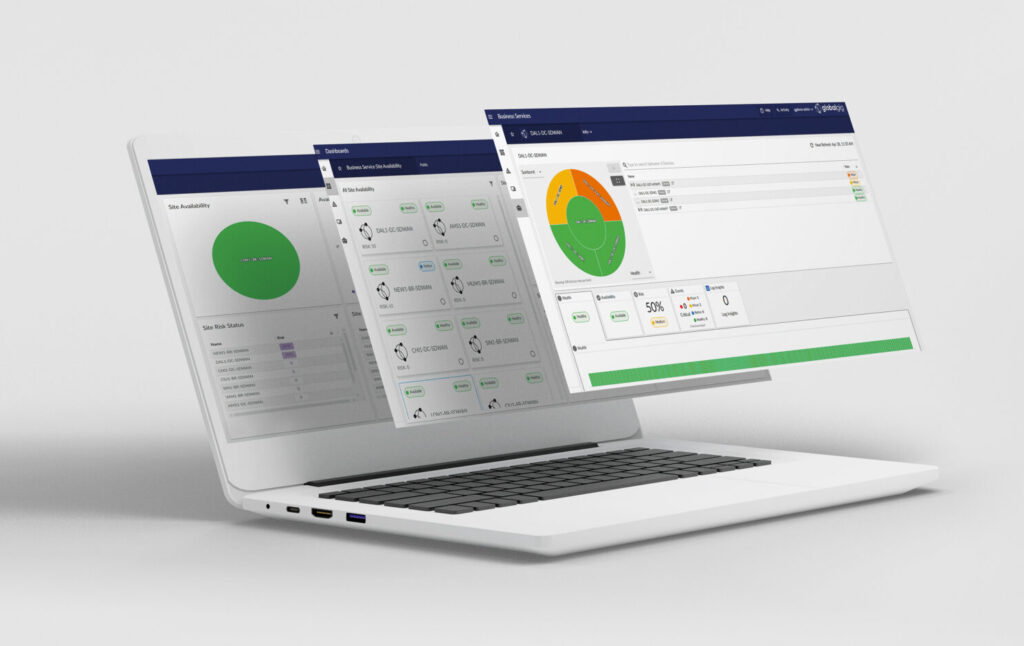
Managing wireless services across multiple carriers, countries, and device types without a unified platform means team members are reconciling data that should be in one place but often isn’t.
Orchestra puts your entire wireless estate in one platform, so you finally have complete visibility.

What MVNO-Powered Wireless Management Actually Means
The Old Way
- Locked into a single carrier’s network and commercial terms
- Separate providers for IoT, fixed wireless, and satellite services
- Standard tariffs that do not reflect how your business uses data
- SIM management spread across multiple carrier portals
- Connectivity services only — device and service management are separate
- Every hardware vendor managed separately, wireless services designed for standard sites, while other sites struggle
With Globalgig
- Access to over 600 carriers, offering the broadest global coverage
- One provider across every wireless technology and use case
- Custom rate plans and pooled data buckets built around your application
- Single Orchestra portal across every SIM, device, and country your business operates in
- SIM, device, and management are part of a single service
- Hardware from Peplink, Cradlepoint, Digi International, and Teltonika Networks, managed by a single team, and matched to deployment from enterprise to industrial, maritime, remote, and high-availability environments
- Proactive managed network services with 24/7 NOC monitoring, fault management, and device maintenance handled by Globalgig
Wireless Network Management Service Tiers


Frequently
Asked
Questions
How does Globalgig’s eSIM management handle carrier switching without access to the physical device?
Globalgig’s eSIM manages carrier profiles electronically. When a carrier change is required, the new profile is electronically pushed to the eSIM-capable device, activating the new carrier without physical access. This is valuable for IoT devices deployed in remote or hard-to-reach locations where physically replacing a SIM would be operationally impractical or expensive.
How does Globalgig address security across wireless and IoT deployments?
Security is built into your wireless service at multiple levels. At the SIM level, Orchestra provides geo-fencing to block service outside permitted regions, IMEI locking to prevent eSIMs being used in unauthorized devices, and usage anomaly detection to flag unusual consumption patterns. At the network level, private networks and static public IPs keep traffic off the public internet. For organizations that need to extend Zero Trust, endpoint protection, or network segmentation across their wireless and IoT estate, Globalgig’s security portfolio integrates directly with wireless connectivity as a unified managed service.
How does a LEO satellite compare to traditional satellite connectivity?
A traditional geostationary satellite operates from around 36,000 kilometers above Earth, which creates significant latency, typically 600 milliseconds or more. This latency makes it unsuitable for real-time applications, voice, and video services. A LEO satellite operates at between 550 and 1,200 kilometers, which reduces latency to 20 to 40 milliseconds, and delivers throughput that is comparable to fixed broadband.
The leading LEO providers in the enterprise space include Starlink Business, Amazon LEO, Eutelsat, and Telesat. Each offers high-throughput, low-latency connectivity services that have transformed what is possible for remote and mobile deployments.
Globalgig can advise on your satellite connectivity options as part of a broader wireless deployment, including hybrid configurations that combine satellite with cellular services for resilient multi-transport connections. Speak to us about your specific situation, and we will help you work out the right approach.
Can you integrate satellite connectivity with cellular services for a hybrid connection?
Yes, we design and manage hybrid connections that combine a LEO satellite with cellular services, using multi-WAN bonding to create a single resilient transport. Satellite can operate as the primary connection, as a failover path, or as a load-balanced layer alongside cellular services, depending on your coverage requirements and application priorities.
What is SpeedFusion, and why does it matter?
SpeedFusion is Peplink’s proprietary multi-WAN bonding technology. It combines multiple cellular connections, across different carriers, into a single resilient connection, with automatic failover and traffic steering. For deployments where reliable connectivity is critical and a single carrier network is not sufficient, SpeedFusion-enabled hardware provides a meaningful step up in resilience.
Which wireless hardware partners do you work with?
Our primary wireless hardware partners are Cradlepoint, Digi International, Peplink, and Teltonika Networks. We recommend hardware based on your deployment requirements, rather than defaulting to one partner for everything.
Can you support IoT deployments at scale across multiple countries?
Yes, our IoT connectivity service is built for global deployments, with carrier relationships and SIM options designed for low-power, low-data IoT applications, as well as high-throughput connected device use cases. Everything is managed through a single portal, regardless of how many countries or carriers are involved.
What is a low Earth orbit satellite (LEO), and when is it relevant?
A low Earth orbit satellite provides high-throughput, low-latency connectivity services via satellites operating closer to Earth than traditional geostationary systems. It is particularly relevant for remote sites, maritime deployments, and locations where terrestrial 4G/5G coverage is unavailable or unreliable. We offer LEO satellite connectivity as part of our wireless portfolio, and can integrate it alongside cellular connectivity for resilient hybrid connections.
Do you offer eSIM?
Yes, we offer single IMSI, and eSIM options, with full management through the Orchestra eSIM portal. An eSIM is useful for deployments where physical SIM management at scale is operationally difficult, or where devices need to switch networks, without a physical SIM replacement.
I have heard the term ‘service bucket.’ Is that the same as a pooled or shared plan?
It can be, but not always. Service bucket is a term some carriers and providers use loosely to describe a block of data allocated to a group of SIMs or devices. Depending on the provider using it, this may refer to a pooled plan, shared plan, or something in between. The terminology is not standardized across the industry.
Globalgig uses two distinct constructs: pooled data plans, where a group of SIMs draws from a shared allowance with usage floating across devices, and shared plans, where multiple carriers or services are combined under one rate structure for multi-country deployments. If you have been quoted a service bucket by another provider and want to understand how it compares to what Globalgig offers, speak to us and we will clearly outline this.
What service options are available for wireless networking?
Globalgig offers three options, depending on how much you want us to manage. SIM-only services offers SIM supply and carrier access, self-managed through your team. SIM and hardware services add device procurement, configuration, and management alongside your SIM estate. SIM, hardware, and Premier Managed Network Services is the complete service, adding 24/7 NOC monitoring, proactive fault resolution, incident response, and direct access to senior engineers. Most customers start with one option and upgrade as their requirements grow.
Do you offer satellite connectivity?
Yes, we offer LEO satellite connectivity for remote and maritime locations where terrestrial 4G/5G coverage is unavailable, unreliable, or insufficient. It can be deployed as a primary connection, or combined with cellular connectivity for a resilient hybrid connection, which is particularly effective using multi-WAN bonding hardware.
Our industrial environment requires hardware that can handle extreme conditions, and long deployment lifecycles. What should we be looking for?
Industrial deployments have requirements that standard enterprise hardware is not designed to meet. The hardware we recommend shares four characteristics. These are certified operating temperature ranges that cover field conditions, instead of controlled environments; industrial certifications appropriate to the specific deployment, such as C1D2, ATEX, MIL-STD-810H, and E-Mark; long-lifecycle design that allows component upgrades without a full hardware replacement; and remote management capabilities that reduces the need for physical access to devices that are difficult or expensive to reach.
We assess your environment, compliance requirements, and operational constraints before recommending any hardware. The right device for a utility substation is not a suitable device for a logistics vehicle, or a remote agricultural sensor. Speak to us, and we will tell you which platform fits your specific situation.
Can we use wireless OOBM alongside our existing failover?
Yes, wireless failover and OOBM can operate from the same hardware, without additional equipment, keeping costs and complexity low.
What happens during a failover event?
When your primary connection fails, wireless failover activates automatically and traffic switches to a wireless connection at full broadband speeds. When the primary connection is restored, traffic switches back. No manual intervention is required and the switchover is designed to be invisible to your users, who stay connected.
Can wireless work as our only internet connection at a site?
Yes, wireless WAN as primary connectivity is one of the most common use cases, particularly for remote or temporary locations, sites with lower bandwidth requirements, and where fixed-line installation timelines are unacceptable. Globalgig designs the service around your bandwidth and availability requirements.
What is the difference between wireless networking and wireless broadband?
Wireless networking covers the full range of wireless connectivity use cases, including primary connectivity, failover, OOBM, and 5G wireless broadband. Wireless broadband specifically refers to using 5G as a primary internet connection in place of a fixed-line service. Both are delivered through the same carrier relationships, hardware, and management platform.
What does installation involve for a fixed-site LEO deployment?
It involves a satellite terminal with a clear view of the sky, and a power source. Installation is straightforward for most fixed sites and can be completed in hours by a qualified engineer. For maritime and mobile deployments, stabilised antenna systems are available for vessels and vehicles. Professional installation is available under Globalgig’s managed services.
Is a LEO satellite suitable for IoT devices?
It depends on the IoT application. LEO satellite is suitable for IoT deployments in remote locations where cellular coverage is unavailable, such as agricultural sensors, remote industrial monitoring, and maritime asset tracking. It is less appropriate for low-power IoT devices that need to maintain a constant connection on a minimal battery, and where LTE-M or NB-IoT are more efficient. We help you match the right connectivity technology to each IoT application in your deployment.
What is multi-WAN bonding and why does it matter for satellite deployments?
Multi-WAN bonding combines multiple network connections (such as LEO satellite and cellular) into a single resilient transport, with intelligent traffic steering applications to the best available path in real time. For satellite deployments, bonding means that latency-sensitive applications can be steered to cellular services when available, while throughput-heavy applications use satellite capacity. The result is a more reliable and higher-performing connection than either transport alone. Globalgig deploys and manages bonded LEO and cellular configurations using hardware with proven multi-WAN capability.
What is the difference between a LEO satellite as primary connectivity, and as a failover?
As primary connectivity, LEO satellite is the main connection at a site, with no terrestrial alternative. As a failover, LEO satellite operates alongside a primary terrestrial connection, cellular or fixed-line, and activates automatically when the primary fails. LEO latency is low enough to keep active applications running, so users never feel the failover. Many deployments use a hybrid model: LEO and cellular services bonded together, with traffic steered intelligently across both.
Can a LEO satellite replace our fixed-line connection at a remote site?
Yes, for many applications. A LEO satellite delivers performance that is comparable to fixed broadband services for most enterprise workloads, including cloud applications, video conferencing, VoIP, and real-time monitoring. It is worth asking whether your specific applications have latency or throughput requirements that LEO cannot consistently meet at your location. We will give you an honest assessment based on your use case and location before you commit.
Which LEO satellite providers does Globalgig work with?
The LEO satellite market includes several providers serving enterprise customers, including Starlink Business, Amazon LEO (formerly Amazon Kuiper), Eutelsat, and Telesat. Globalgig advises on the right provider for your specific requirements, coverage needs, and hardware preferences. Speak to us about your requirements, and we will help you identify the right approach.
What is a low-Earth orbit (LEO) satellite, and how is it different from a traditional one?
A traditional geostationary satellite operates from around 36,000 kilometers above Earth. At that distance, the round-trip signal time creates latency of 600 milliseconds or more, making it unsuitable for real-time applications. A LEO satellite operates at between 550 and 1,200 kilometers, reducing latency to 20 to 40 milliseconds (over 95% lower latency than traditional geostationary satellite), and delivering throughput comparable to fixed broadband. LEO satellites also provide global coverage, including maritime and polar regions that geostationary systems cover poorly.
We already manage our IoT SIMs through a carrier portal. Why would we move?
A carrier portal gives you visibility into that carrier’s network. Orchestra gives you visibility across every carrier in your estate, in one place, with unified billing, anomaly detection, and API integration into your operational systems. If you operate in one country with a single carrier, the difference is marginal. If your deployment spans multiple markets, your organization has growth plans, or you need the flexibility to switch carriers without renegotiating contracts, it is significant.
What is the difference between LTE-M and NB-IoT?
LTE-M supports higher data rates and device mobility, making it suitable for devices that move, such as asset trackers, wearables, or connected vehicles. NB-IoT is optimized for ultra-low power consumption and devices that are stationary by transmitting very small amounts of data infrequently, including smart meters, fixed sensors, and agricultural monitoring. The choice affects battery life, data throughput, and cost. We help you make the right decision for each device type in your deployment.
What is SGP.32, and why does it matter?
SGP.32 is the GSMA’s IoT eSIM standard that enables remote SIM provisioning for headless devices. Devices with no user interface that may be deployed for a decade or more, without physical access. It allows carrier profiles to be switched remotely, which is essential for large-scale IoT estates in the field. Globalgig supports SGP.32 eSIM lifecycle management through Orchestra, including profile provisioning, carrier switching, and compatibility validation.
How does IoT connectivity create shadow IT risk?
IoT devices frequently connect to enterprise networks outside of formal IT procurement. Operational teams deploy sensors, while your facilities teams add connected equipment. Devices are brought in to solve a specific problem without a security review. Each unmanaged device is a potential vulnerability your security team does not know exists. Globalgig addresses this at the connectivity layer. So, every device managed through Orchestra is visible to your IT team, with usage data, location, and anomaly alerts. Managing IoT connectivity through a single provider means your IT team has a complete picture of what is going on in your network.
What is bill shock in IoT, and how do you prevent it?
Bill shock happens when a device consumes far more data than expected; typically because of a firmware update, misconfiguration, or software bug that creates a data loop. At per-megabyte overage rates, a single device can generate thousands in unexpected charges before anyone notices. Orchestra monitors usage in real-time across your entire estate, sets automated alerts at defined thresholds, and can suspend devices automatically when your usage crosses a limit. The cost visibility that prevents overage is built into the platform, not bolted on.
What is the difference between pooled and shared data?
Pooled data gives your entire device estate a single combined allowance. Every device draws from the same bucket, regardless of country or carrier, so unused data on a quiet device is automatically available to a busy one. It is more efficient, and typically reduces overall waste across large estates.
Shared data assigns individual allowances to each device or group, with usage tracked separately. It gives you more granular visibility into what each device or location is consuming, and more control over per-device spend, but at the cost of some flexibility.
Both models are available through Globalgig, across countries and carriers, on one bill.
Is there a minimum SIM commitment?
This depends on the service level and commercial structure. We work with enterprises ranging from small mobile workforces to large-scale IoT deployments. Speak to us about your specific requirements, and we will build the right commercial model for your organization.
How does eSIM over-the-air management work?
Globalgig eSIM uses patented over-the-air technology to push carrier profiles to eSIM-enabled devices remotely. When you need to switch a device to a different carrier or market, you make the change in Orchestra and the new profile is applied to the device without any physical intervention. This is valuable for devices that are difficult or expensive to access physically, such as remote sites, deployed assets, and large-scale IoT estates.
What API integrations does Orchestra support?
Orchestra offers a full REST API covering SIM inventory, usage data, subscription management, activation and suspension, and billing information. It integrates with fleet management platforms, ERP systems, and IoT application management tools. Your technical team can connect it directly, or you can speak to us about pre-built integrations for common platforms.
Can we activate and suspend SIMs ourselves, or does Globalgig do it?
Both are possible. Orchestra gives your team full self-service control over activation, suspension, and lifecycle management. For organizations that prefer a managed service, Globalgig can handle SIM lifecycle management on your behalf, with changes actioned through a single point of contact.
How does data pooling work across carriers?
Rather than each SIM having its own fixed allowance per carrier, usage draws from a shared pool across your entire estate. Devices that use less than expected free up allowance for devices that use more. It reduces waste, lowers average cost per SIM, and makes your wireless spend more predictable than per-SIM or per-country allocations.
Can we take over management of an existing SIM estate from another provider?
In some cases, yes. The process depends on your current carrier relationships and contract terms. Speak to us, and we will assess what is involved before making any recommendations.
What is the difference between single IMSI, multi-IMSI, and an eSIM?
A single IMSI SIM is tied to one carrier profile, so it is suitable for fixed deployments in a single market. A multi-IMSI SIM carries multiple carrier profiles and connects to the best available network, making it ideal for devices that operate across multiple countries. An eSIM goes further: profiles are managed over the air, so carrier switching and profile changes happen remotely, without any physical SIM replacement. For global deployments, an eSIM typically delivers the most operational flexibility and lowest long-term management overhead.
How does a LEO satellite integrate with SD-WAN?
LEO satellite can be added as a transport layer in your SD-WAN deployment, alongside dedicated internet, broadband, MPLS, LTE, and 5G. SD-WAN policy management then handles traffic steering across all available transports, based on application priority, path performance, and availability. For sites where LEO is the primary or sole transport, SD-WAN provides the application-aware routing and failover management that optimizes how that connection is used.


Get a Clear View of Where Wireless Fits in Your Network
Wireless can solve different problems across different parts of your business, but the right model depends on the location, carrier availability, hardware, security needs, and how the deployment will scale.
Speak to a specialist to compare what will work best and bring your wireless services into one clearer, easier-to-manage plan.