
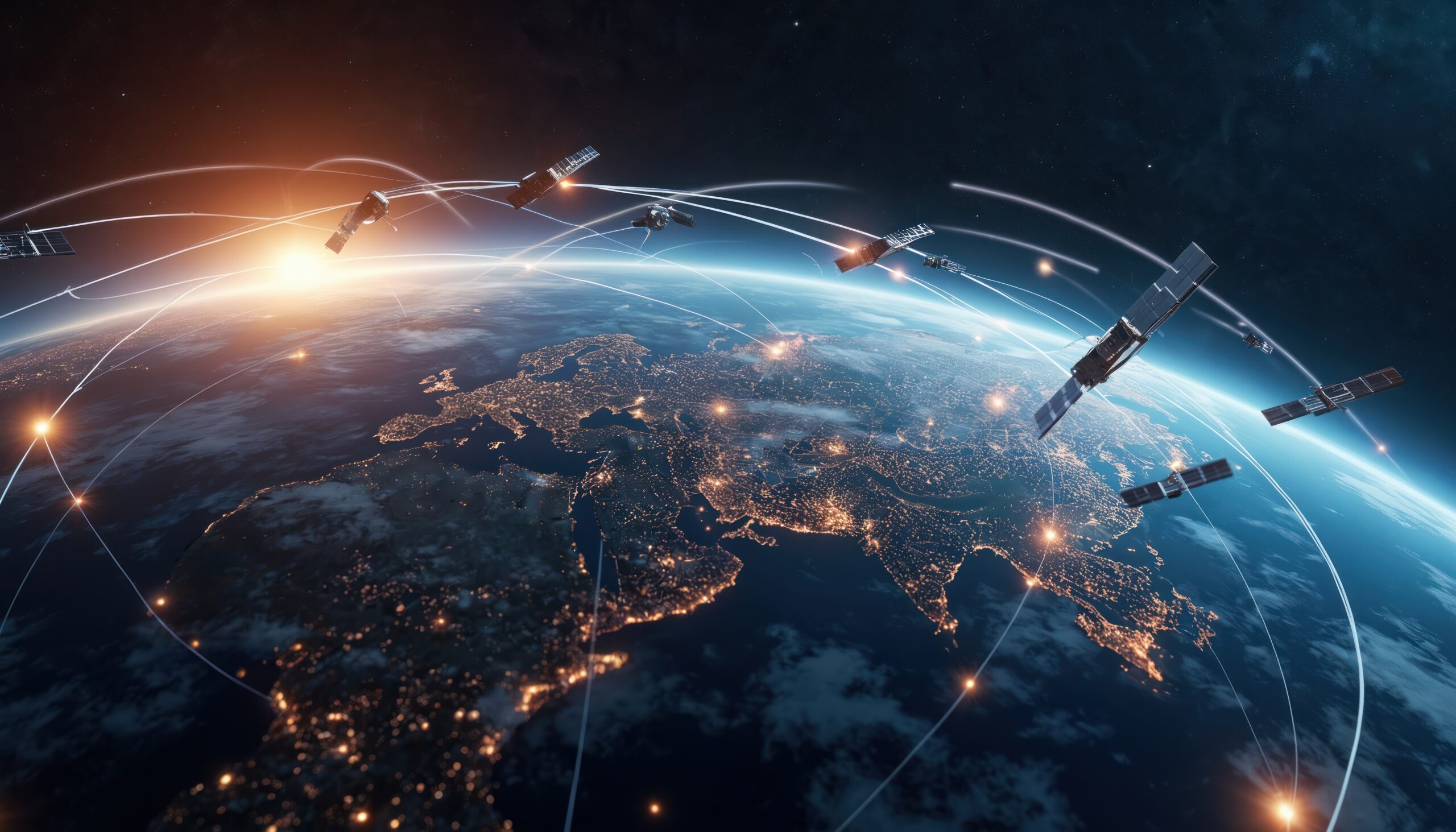
Severe power outages in Spain and Portugal in early 2025 knocked out communications and brought most businesses to a standstill – and with downtime estimated to cost well over half a million dollars per hour, that’s time that few organizations can afford. Low earth orbit (LEO) satellite connectivity could have mitigated these impacts, but how does it work and how can it help businesses deal with unforeseen outages?
It’s every organization’s worst nightmare. Your staff are busy dealing with customers, fulfilling orders, and collaborating with suppliers and partners – and then your network connections go down.
These days, that means total shutdown for most organizations. Without access to cloud services and data centers, or communications with other staff and with the outside world, business screeches to a halt.
That was the reality for thousands of businesses in Spain and Portugal in early 2025, when widespread power blackouts took out both fixed and cellular connectivity.
The effects were massive. It’s estimated that unplanned downtime costs an average of $9,000 per minute, or $540,000 every hour, and GDP in Spain alone was estimated to have been hit by 1.6 billion euros.
Connectivity Means Continuity
For some businesses, like those in the food and manufacturing sectors, a lack of power puts an almost complete stop to business operations. But that’s not true for all organizations.
So long as they have connectivity, many organizations could continue functioning for some time during a blackout using battery-powered equipment like laptops and Point of Sale (PoS) devices, or with backup generators.
With connectivity, most businesses can continue to make sales. Office staff can connect to cloud services and communicate with each other, and with customers and suppliers. Delivery systems will stay up, so deliveries will still be made. Supply chains aren’t disrupted, and planning and procurement can carry on as normal.
Before we dig into how LEO satellite connectivity could have helped in this situation, let’s look at the question of network redundancy and how it ensures an organization has uninterrupted connectivity.
All Network Redundancy Is Not the Same
Basic network redundancy means having more than one connection into a location. So a business using fiber connectivity, for example, could have a secondary fiber link as a backup.
The problem here is that an issue with the primary connection – like a backhoe damaging the duct carrying the cable – is likely to affect the backup link too. Similarly, one mobile supplier’s network going down might affect another provider’s network too.
Greater redundancy comes from having two or more types of connectivity that use different paths. For example, this might be a primary fiber connection and a Fixed Wireless Access (FWA) connection as backup.
During the Iberian power outage, however, both fiber and cellular networks were badly affected. Few cell towers have backup generators, and fixed networks rely on local and regional equipment – like routers, switches and amplifiers – that need power to work.
It’s not just power outages that can impact both fixed and mobile communications, however. Events like severe wildfires and floods also have the potential to affect both.
When combined with a fixed or wireless service, satellite connectivity offers a very high level of network redundancy. That’s because satellite connectivity is much less likely to be affected by what’s happening on earth, like blackouts or natural disasters.
What Are LEO Satellites?
LEO satellites orbit at heights of between 200 and 2,000km above the planet. They’re different from geosynchronous satellites, which orbit at a height of about 36,000km and appear to be largely stationary in the sky, as they rotate at roughly the same speed as the earth.
Because they’re closer to the earth, LEO satellites offer broadband connectivity with much lower latency than geosynchronous satellites. However, they also rotate faster – usually taking around one and a half to two hours to orbit the earth – so a “constellation” of LEO satellites is needed to give full coverage in all areas.
In 2024, there were around 8,000 LEO satellites in orbit, but this number is growing quickly as investment in this area continues. The most well-known LEO satellite provider is Starlink, but Amazon and other companies are also beginning to deploy large numbers of satellites, so in the future, enterprises will have more options to choose from.
How Does LEO Satellite Connectivity Work?
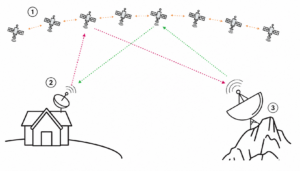
- A “constellation” of satellites is launched into orbit to provide full coverage around the globe. Because the satellites are orbiting rapidly, data might be received back from a different satellite to the one the request was made from.
- A small dish or antenna at the organization’s site continuously tracks the satellites for the best possible performance. The antenna connects to a router within the premises, which provides connectivity for the devices at that location.
- Ground stations send and receive signals to and from the satellites and provide connectivity to the rest of the internet.
We’re also beginning to see the first services offering connectivity directly from the satellite to mobile devices, which is sometimes known as Direct-to-Device (D2D).
Satellite Offers True Network Diversity
Although satellite broadband has many uses as a primary connection – particularly in under-served and remote areas – it’s a strong choice for backup connectivity to provide greater network resilience. If an organization relies on a fixed or cellular link for connectivity, adding a satellite link provides true network diversity.
In the Iberian example, a business with satellite connectivity could have stayed connected so long as it had a backup generator or emergency power source to run the router – even though terrestrial fixed and mobile networks had largely failed.
Consumers using Starlink during the power outage, for example, reported continued connectivity thanks to the company’s laser mesh network.
Each of Starlink’s satellites is designed to connect to its neighbors using laser links. Although the company’s local ground stations stopped working soon after the power cut, this mesh system allowed traffic to be rerouted via a series of satellites to ground stations in other countries instead.
Satellite Can Mitigate the Serious Effects of Unexpected Outages
LEO satellite isn’t entirely without drawbacks. It’s not always as cost-effective as fixed or mobile services, it can be affected by severe weather, and it may not offer quite the same speed, capacity and latency. However, as the number of satellites in orbit and the choice of providers continues to grow, it’s becoming an ever-more-valuable option for organizations that simply can’t afford the potentially massive impact of network downtime.